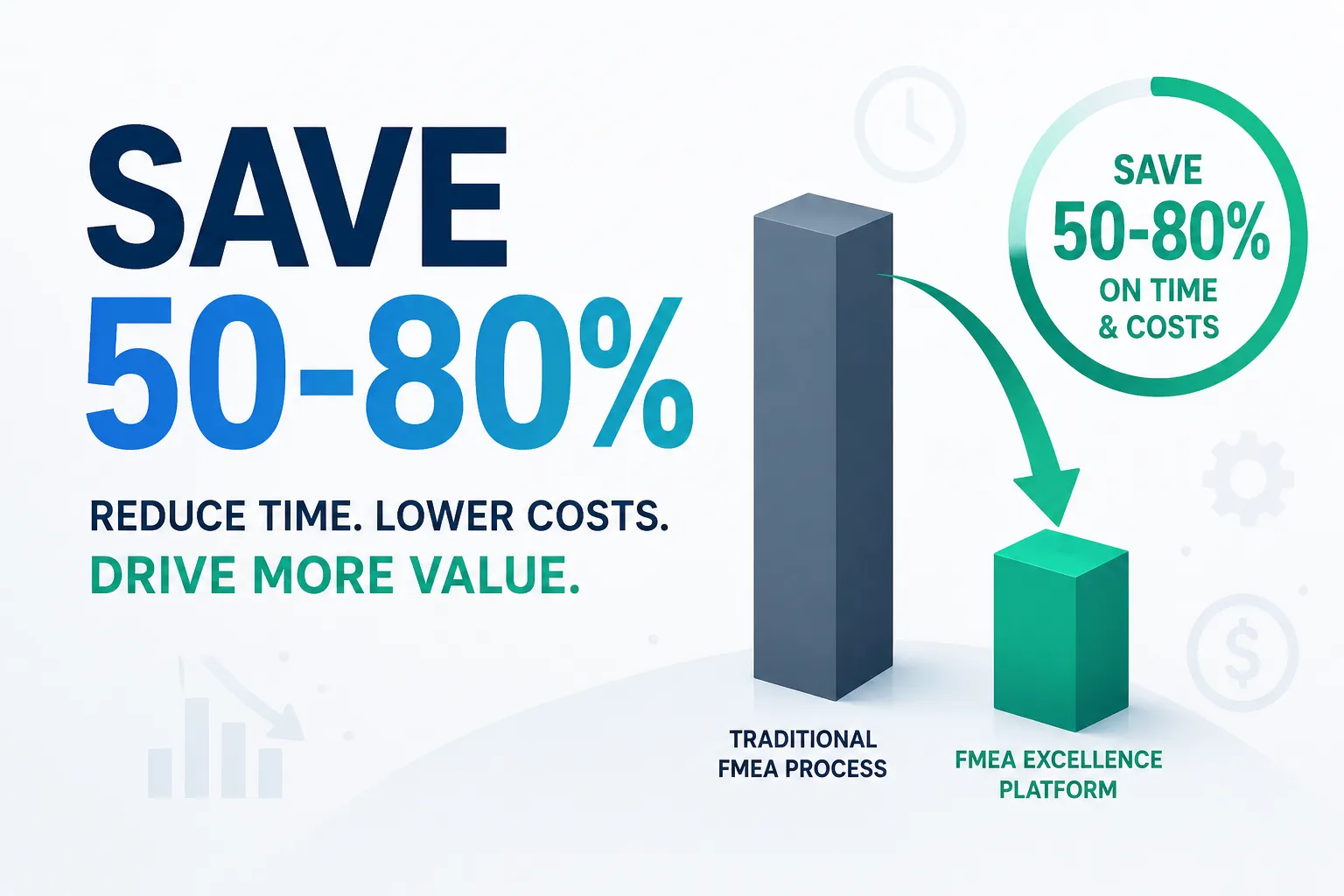
How to Give Engineers Back 50–80% of Their Time: FMEA Process Automation as the Key to Efficiency
Introduction: When FMEA Consumes More Resources Than It Prevents Risk
In many organizations, FMEA is intended to be a risk-reduction tool, but in practice it often becomes one of the largest consumers of time and resources. Creating new FMEA analyses, PFDs, and Control Plans, continuously updating them, and manually defining parameters in accordance with the FMEA Handbook require significant engineering effort—often without proportional added value.
The result is familiar: overloaded teams, project delays, and a focus on administration instead of decision-making.
Problem 1: Inefficient Use of Time and Resources
Traditional FMEA processes rely on:
- manual work in spreadsheets,
- repeating the same structures from project to project,
- multiple revisions of the same documents, and
- dependence on individual engineers’ experience.
In such an environment, a large portion of time is spent on operational tasks rather than on risk analysis and risk management.
Solution: Automation That Frees Up Resources
Modern FMEA systems, such as FMEA EXCELLENCE, enable:
- a 50–80% reduction in time and resource consumption,
- automatic generation and maintenance of FMEA, PFD, and Control Plan documentation,
- process standardization without additional administrative burden.
Automation does not replace engineers—it gives them back time for what truly matters.
Problem 2: Difficulties in Creating New PFDs, FMEAs, and Control Plans
Documentation for each new project often starts “from scratch,” even though organizations already possess extensive knowledge from previous projects.
This leads to:
- duplication of work,
- inconsistent structures,
- increased risk of errors, and
- non-compliance with standards and internal rules.
Solution: FMEA and Control Plan Families
By using FMEA and Control Plan families, FMEA EXCELLENCE enables:
- automatic creation of new documentation based on existing, similar processes,
- rapid adaptation to the specifics of a new project,
- consistent application of standards and best practices.
Instead of rewriting documents, they are intelligently inherited and adapted.
Problem 3: Updating FMEA Analyses Is Slow and Unreliable
In real production environments, changes occur daily:
- increased scrap rates,
- rework,
- customer complaints, and
- changes in process parameters.
However, FMEA often remains unchanged because manual updates are slow, demanding, and error-prone.
Solution: Automatic Updates Based on Real Data
FMEA EXCELLENCE enables automatic updating of FMEA analyses through:
- import of PPM data,
- integration of scrap, rework, and complaint data (COPQ – Cost of Poor Quality),
- connectivity with ERP systems.
This ensures that FMEA reflects the actual state of the process rather than remaining a static document.
Problem 4: Manual Definition of S/O/D/AP Parameters
Defining Severity, Occurrence, Detection, and Action Priority parameters is often done:
- manually,
- with constant reference to the AIAG & VDA FMEA Handbook (2019),
- through Excel spreadsheets, and
- with significant room for subjectivity.
This approach not only consumes time but also introduces inconsistency into risk assessments.
Solution: An Expert System for Decision-Making
FMEA EXCELLENCE uses an AI-based expert system that:
- automatically proposes S/O/D/AP values,
- applies the rules defined in the AIAG & VDA FMEA Handbook,
- ensures consistency and traceability of decisions,
- reduces subjectivity in risk assessment,
- supports priority-setting decisions by considering a broader set of relevant parameters.
In today’s environment—where prioritization is one of the greatest challenges and consumes significant engineering time—the system uses AI analysis to simplify and accelerate decision-making. Engineers no longer “fill in tables”; they validate and enhance intelligent system recommendations.
Conclusion: Efficiency as a Competitive Advantage
In an environment where speed, quality, and compliance are critical competitive factors, manual and fragmented FMEA processes become a serious limitation.
By automating key FMEA activities:
- time is returned to engineers,
- resources are used more intelligently,
- risks are identified earlier, and
- decisions are made faster and with greater confidence.