What Is FMEA? A Complete Guide to Failure Mode and Effects Analysis
What Is FMEA?
Failure Mode and Effects Analysis (FMEA) is a structured, team-based method for identifying potential failure modes in a product or process, understanding their causes and effects, and taking preventive action — before failures reach the customer.
Originally developed by the US military in the 1940s and later adopted by NASA, FMEA is today a cornerstone of quality engineering in the automotive, aerospace, medical device, and manufacturing industries.
Why FMEA Matters
Modern products and production processes are complex. A single unaddressed failure mode can lead to:
- Customer safety incidents and product recalls
- Costly warranty claims and liability exposure
- Regulatory non-compliance (ISO 9001, IATF 16949, FDA)
- Production downtime and material waste
FMEA shifts the quality mindset from reactive (fixing problems after they happen) to proactive (preventing problems before they occur).
How Does FMEA Work?
The FMEA process follows a structured five-step cycle:
- Define the scope — Identify the product, system, or process under analysis.
- List failure modes — For each function, determine what could go wrong.
- Analyze effects and causes — Assess the impact of each failure and its root causes.
- Score with RPN — Rate each failure mode on Severity (S), Occurrence (O), and Detection (D), then calculate the Risk Priority Number (RPN = S × O × D).
- Define actions — Assign corrective or preventive actions to reduce the highest-risk failure modes.
RPN = Severity × Occurrence × Detection
Each factor is rated 1–10. A high RPN (e.g., above 100) signals a failure mode that demands immediate attention.
The Two Types of FMEA
There are two primary types of FMEA used in industry. Both are supported in the FMEA Excellence application.
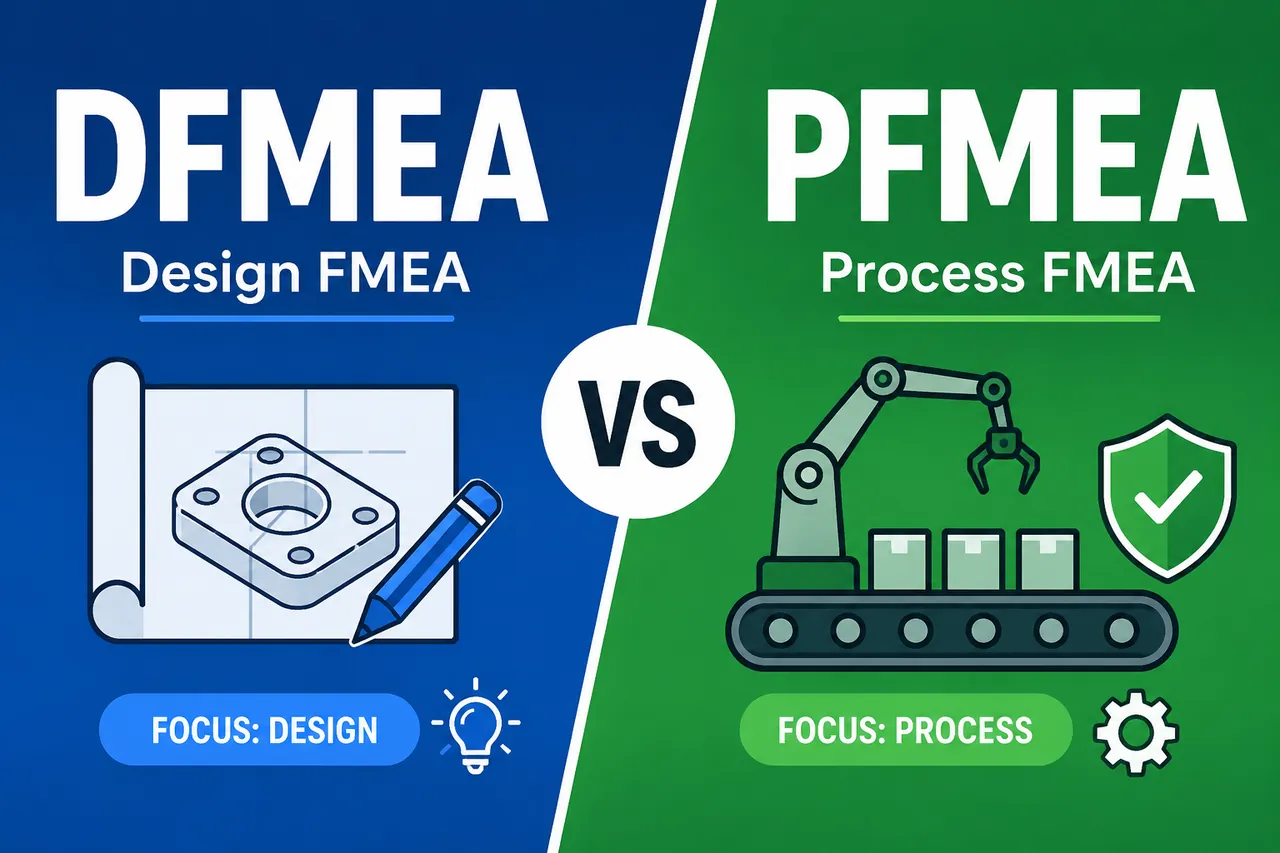
Visual comparison of DFMEA and PFMEA
DFMEA — Design FMEA
DFMEA (Design Failure Mode and Effects Analysis) evaluates potential failures that originate in the product design itself.
What DFMEA covers
- Design requirements and functions - Component-level failure modes - Interface and interaction failures - Safety and regulatory compliance risks
DFMEA is conducted by design engineers early in the product development cycle, helping teams make better design decisions before tooling and production begin.
PFMEA — Process FMEA
PFMEA (Process Failure Mode and Effects Analysis) evaluates potential failures that occur during manufacturing, assembly, or service processes.
What PFMEA covers
- Manufacturing process steps - Machine, tooling, and fixture failures - Human error and operator variation - Measurement and inspection failures
PFMEA is conducted by process and manufacturing engineers to ensure that a good design can be consistently produced at quality standards.
FMEA Standards and References
The most widely referenced FMEA standard in the automotive industry is the AIAG-VDA FMEA Handbook (2019), which introduces the 7-Step FMEA approach and replaces the older RPN-only methodology with a more structured Action Priority (AP) system.
Other key standards and frameworks that reference FMEA:
- IATF 16949 — Automotive quality management system standard
- ISO 9001 — General quality management, risk-based thinking
- IEC 60812 — FMEA procedure for electronic components
- ARP4761 — FMEA in aerospace and defense
FMEA Excellence: AI-Powered FMEA
The FMEA Excellence application supports both DFMEA and PFMEA with an AI-assisted workflow, helping engineering teams complete analyses faster, with greater consistency and auditability.
FMEA Excellence provides structured templates for AIAG-VDA 7-Step FMEA, AI-assisted failure mode generation, real-time collaboration, and export-ready reports — in both English and Serbian.
Frequently Asked Questions
What is FMEA?
FMEA (Failure Mode and Effects Analysis) is a systematic, proactive method for identifying potential failure modes in a product or process, assessing their severity and likelihood, and prioritizing corrective actions to prevent defects before they occur.
What are the two main types of FMEA?
The two main types of FMEA are DFMEA (Design FMEA), which focuses on potential failures in a product design, and PFMEA (Process FMEA), which focuses on potential failures in a manufacturing or assembly process.
What is the difference between DFMEA and PFMEA?
DFMEA analyzes failure risks in product design to ensure the design meets requirements, while PFMEA analyzes failure risks in production processes to ensure manufacturing quality. Both complement each other in a complete quality management system.
Who uses FMEA?
FMEA is widely used in automotive, aerospace, medical device, electronics, and manufacturing industries. Standards such as AIAG-VDA FMEA Handbook and ISO 9001 recommend or require it as part of risk-based quality management.
What is the RPN in FMEA?
RPN (Risk Priority Number) is calculated by multiplying three scores: Severity (S), Occurrence (O), and Detection (D). It ranks failure modes so teams can prioritize which risks to address first.